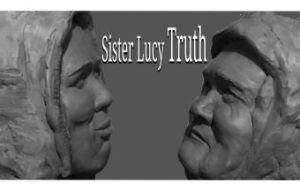
AI Analysis of Sr Lucy’s true ID
Sr Lucy 1 – Sr Lucy 2
Is the right-hand picture that of the same woman 20 years later…. or an imposter?
The controversy over Sr. Lucy’s true identity after about 1960 has persisted since the 1970s
up to today. Prior coverage has included opinions from various religious and scientific
sources, including a prior forensic study done by the author, which found objective facial
characteristics varied significantly between the two subjects, leading to a conclusion that
the facial variation was so extreme (13 million to one) that the identity of Sr Lucy 2
was not the same as Sr Lucy 1.
The recent advent of powerful analytic tools developed for Artificial Intelligence (AI) has
suggested a refinement and repetition of the original forensic analysis cited above, but
using the processing power of the latest AI tools.
GROK , the AI tool of choice, was asked to apply the scientific method by testing the
hypothesis that Sr Lucy 2 was an imposter with the forensic analysis of facial features of Sr
Lucy 1 and 2 alone, not relying on opinions or beliefs of other sources.
GROK analysis with forensic conditions
Note the thorough rigorous scientific approach of AI;
- High-resolution photos of Sr Lucy are collected from 1917 to 2005.
- All images were re-sized to a standard to eliminate the effect of different image
sizes.
- Thirteen standard international parameters used for facial recognition were
selected, targeting bone structure over soft tissue.
- These were cross-referenced with expert reports to validate agreement with direct
computation.
- Most parameter tests show structural inconsistencies incompatible with natural
aging.
- The similarity ratios vary from 0.1 to 0.5, where a match is considered possible if the
ratio is greater than 0.7.
- Structural differences are immutable post-childhood and cannot result from 50+
years of aging, dental work, or photo artifacts.
- Three other scientific analyses agree with this AI report.
size of sample: 26
GROK response: Probability They Are the Same Person: < 5%. Probability They Are
Different Persons: > 95%.
………
The importance of prompting AI with proper instructions was made very clear when the
same identity test was requested of AI,
but without the directive to use scientific principles.
The actual prompt: Please research the Sr Lucy imposter claim and give your objective
probability that the Imposter hypothesis is true.
With no rules of truth (epistemology) defined, the GROK AI agent employed its default
search instructions to use its learning set, based on Web sites, books and documents in
the public domain, to determine a statistical average of global opinions. GROK states that a
Bayesian approach was employed: Start with a low prior history (~1%) for large-scale
religious conspiracies succeeding undetected, based on historical precedents (like
Watergate leaks) and update with evidence
GROK analysis without forensic conditions
Resulting probability: ~3% that the imposter hypothesis is true. ~ 97% that the
imposter hypothesis is false
The reversal is stunning! When a scientific forensic analysis is requested of AI, the
evidence is overwhelming in favor of an imposter interpretation.
When AI is free to choose its pre-programmed sources as available in public discourse, the
conclusion is almost perfectly flipped in favor of equal identities!
……
Let’s reflect on the case above – of determining the true identity of Sr Lucy through the
years. The GROK AI tool was first prompted to do a forensic test of photos using facial
features. This technology is effectively used globally for facial recognition by
governments, investigative agencies and general surveillance…especially by China!
AI is intended/programmed to be truthful, useful and helpful to the prompter. So
properly forming prompts is a skill that AI users will have to master.
In the first prompt, no hint was given as to the expected outcome. Just the forensic
nature of the test, which forces other options to be eliminated. The resulting response
found that an imposter was 95% probable.
Second prompt: the decision of test method was open and left up to GROK, so it
chose the default strategy: to use its learning set based on all public knowledge
sources, including unrestricted Web sites, news and history books.
The AI response was based on what sources were chosen. The result was a complete
logical reversal of the first prompting: an imposter was only 3% probable. Same AI
source but different prompts; not different, perhaps, to many people, but definitely
different to AI. One prompt was based on the scientific method; the second on public
hearsay.
So, what are the rules of operation for AI prompters?
AI prompts are instructions, questions, or text given to generate a specific response.
Output quality depends on prompt input quality – “Garbage In; Garbage Out”. Effective
prompts are clear, specific, and provide sufficient context for AI to understand the
user’s intent. Prompts are important for quality control, task guidance and efficiency
(avoiding follow-up requests).
The exact prompt used must be stated, along with the result.
Examples of bad prompts: Hint at an expected outcome, like pointing out the cause
for the chin differences in the photos. AI would follow its directive to be helpful and
focus on the chin shape to decide the identity.
Using 4 photos instead of 26 would produce more statistical variability and logical
uncertainty.
………..
GROK summarizes the claims of true identity supporters but omits any responses by
imposter believers. Here is now summarized the identity claims and responses, which a
balanced analysis would have provided.
Identity Supporter Claim => Imposter Supporter Response
- The alleged “Sister Lucy II” => reflects patent bias of the AI sources
- Imposter theory relies on circumstantial evidence, => scientific/forensic evidence
is NOT circumstantial.
- .. details not published in academic journals. => not an apt topic for elite journals!
- No DNA testing, exhumation, or official records support replacement. => not
consistent treatment of a cloistered religious.
- Aging, lighting, health explain variances. => None of these explain the bone
formation variances.
- A 2018 Facebook analysis (from a pro-Church source) calls it “not true,” =>
Assertion without evidence
- Replacement would require deceiving her family, 80+ convent sisters, popes, and
global Fatima pilgrims =>
Sr Lucy had very few visitors; limited visits were held behind a curtain and
monitored by the headmistress, who often replied for
Sr Lucy. A religious cloister is a monastic place of seclusion; a space for quiet
religious life, from the Latin for “to shut up”.
- …isolation aided privacy, but not wholesale deception. => the cloister enforced
total visual isolation
- Handwriting changes could reflect age or secretaries. => ‘could’ not evidence…
- The imposter theory thrives in anti-Vatican II groups. => and the single ID theory
thrives in Vatican II groups.
- “proper forensics/DNA” for proof. ; no controlled study. => This.
- Imposter “experts” are not independently verified; => Speaking only for the four
forensic reports, all are professionally qualified.
- No major forensic body endorses imposter theory. => Were any asked to do so?
The UN hasn’t endorsed either theory!
- Identity deniers align with sedevacantist agendas => Supporters align with Vatican
power brokers.
- No DNA/exhumation; fringe analyses only. => not consistent treatment of a
cloistered religious.
- Denier evidence is biased sampling =>…biased by being the only available
photographic proof.
- Implausibility and unfalsifiable => The Vatican sex scandal was also thought
implausible… Falsification is blocked by the Vatican, not by imposter believers
- No smoking gun (e.g., DNA) => Falsification is blocked by the Vatican, not by
imposter believers
- Overwhelming likelihood it’s a misinterpretation fueled by theological disputes
=>Not according to scientific forensic reports!
- independent DNA from her grave would be decisive. => blocked by the Vatican, not
by imposter believers
- Catholic Answers notes: “There is no evidence that she (Sr Lucy) was ever ‘replaced’
by an impostor or that the Church covered up anything about the appearances of
Our Lady of Fatima.”
=> The author’s experience w/ CA perhaps is relevant….. When I noted in a
comment at the CA Website that Stephen Hawking was a member of a papal
advisory group, the Pontifical Academy of Science, and also a professed atheist, I
was blocked from further access to the Website by a CA representative who insisted
that no atheist was on the PAS.
Yes, Stephen Hawking was an atheist, stating in an interview that, “I’m an atheist”.
He explained that while he once used the phrase “know the mind of God” in his
book A Brief History of Time, he came to believe that science provides a more
convincing explanation for the universe, making God unnecessary.
Religious arguments are made that the imposter position is a ‘conspiracy theory’,
motivated by those Catholics opposed to the pope or to secular positions taken by the
Vatican administration . Questioning the Catholic hierarchy is to question their divine
authority. Yet ancient and recent faith leaders have been guilty of deception.
Religious Conspiracy theories that were factual
Denial of Christ’s Resurrection
The most famous —and relevant— conspiracy claim. Jews conspired to deny and suppress
the news of the Resurrection of Christ. A lie which endures today – 2000 years after the
event.
Matt 28:11 Now while they were going, behold, some of the guard came into the city and
reported to the chief priests all the things that had happened. When they had assembled
with the elders and consulted together, they gave a large sum of money to the
soldiers, saying, “Tell them, ‘His disciples came at night and stole Him away while we
slept.’ And if this comes to the governor’s ears, we will appease him and make you
secure.” So they took the money and did as they were instructed; and this saying is
commonly reported among the Jews until this day.
Catholic Church Sex Abuse Cover-up
For decades, isolated allegations suggested that Catholic Church leaders were quietly
shuffling accused priests between parishes to hide widespread child sexual abuse. These
claims were often met with denial or seen as anti-Catholic smears. However, extensive
investigations have proven there was indeed a systematic cover-up. From the mid-20th
century through the 2000s, Church hierarchy – yes, all the way up to the Vatican – routinely
suppressed abuse reports, protected predator priests, and silenced victims to avoid
scandal. A Pennsylvania Grand Jury in 2018 documented over 1,000 cases of child abuse
by 300+ priests and concluded that “senior church officials…knew about the abuse… but
routinely covered it up,” in a conspiracy spanning decades. Millions of dollars in restitution
were paid out.
Similar investigations around the world (Ireland, Australia, Boston in the U.S., etc.)
uncovered secret archives and correspondence proving that Church leaders reassigned
abusive clergy and kept crimes hidden from law enforcement. What many victims and
whistleblowers long claimed – and many others refused to believe – was undeniably
validated by these reports: the Catholic Church engaged in a long-term conspiracy to
conceal abuse cases.
Sometimes, conspiracy claims that were widely dismissed end up being validated by
evidence years later, as per below.
Tuskegee Syphilis Experiment (Government Medical Cover-up)
CIA’s Project MKUltra (Mind Control Experiments)
FBI COINTELPRO (Domestic Spying and Sabotage)
Big Tobacco’s Cover-up of Smoking Dangers (Corporate Conspiracy)
Operation Northwoods (Military False-Flag Plot)
NSA Mass Surveillance (Warrantless Spying Program)
Conclusion:
AI is a useful research tool, able to rapidly discern knowledge that leads to the truth,
but also fraught with dangers of misinterpretation and misunderstanding via
prompting misdirection.
Many AI models fail “stochastic parrots” tests—e.g., they invent plausible but wrong
Physics proofs when prompted outside training data.
Scientific testing shows Sr. Lucy 2 was an imposter; public opinion says no.
Part II
Overview of the Sister Lucy Imposter Claim “Sister Lucy imposter” theory posits that Lúcia dos Santos (1907–2005), one of the three child visionaries of the 1917 Our Lady of Fatima apparitions in Portugal, was replaced by an impostor sometime after the 1940s or early 1950s—most proponents specify around 1957 or definitively by 1967. The alleged “Sister Lucy II” (the public figure seen from that point until her death) is claimed to be a different woman, possibly Mother Maria Celina of the Holy Face (a Carmelite nun and superior at the same convent in Coimbra, Portugal), installed as part of a Vatican-orchestrated cover-up to suppress or alter the Fatima messages, particularly the Third Secret (revealed in 2000) and calls for Russia’s consecration. Proponents argue this deception allowed the Church to downplay apocalyptic warnings and align with post-Vatican II changes. This theory originated in traditionalist Catholic circles in the 1980s–1990s, gaining traction in sedevacantist (those rejecting post-1958 popes) and Fatima-devotion communities. It has been amplified online since the 2010s via sites like Tradition in Action and Sister Lucy Truth, YouTube videos, and social media discussions on X (formerly Twitter). Key Evidence Claimed by Proponents rely heavily on circumstantial and interpretive evidence, often from self-commissioned analyses. From the provided link (Tradition in Action) and related sources:
- Photographic Comparisons: Side-by-side images from pre-1957 (e.g., 1940s convent photos showing a slender face, prominent smile, and specific eye shape) versus post-1960s (e.g., wider jaw, different chin, recessed smile). Five professional photographers (unnamed in summaries) and a Brazilian forensic expert (Prof. Carlos Bezerra) allegedly concluded via 3D modeling that bone structure differences prove two people, not aging or surgery.
traditioninaction.org
Sister Lucy Truth site (2022 analyses) adds age-regression software showing “insuperable” facial mismatches.
sisterlucytruth.org
- Handwriting and Biographies: Post-1960s letters and memoirs (e.g., Calls from the Message of Fatima, 2000) show stylistic shifts from earlier writings, per graphologists. Biographies describe personality changes (e.g., the “real” Lucy as shy vs. the later one as outgoing).
- Behavioral Anomalies: Photos of the older Lucy using modern tech (e.g., a word processor in 1993) or smiling atypically; claims she contradicted early Fatima emphases (e.g., on Russia’s conversion).
- Recent Developments: A June 2025 YouTube discussion by Dr. Peter Chojnowski (Sister Lucy Truth affiliate) claims a coroners’ conference in Ohio reviewed photos and “agreed” on replacement, even suggesting possible murder of the real Lucy (no independent verification found; appears to be a proponent presentation).
These are presented as “unanimous” among consulted experts, but details (e.g., methodologies, peer review) are sparse and not published in academic journals. Critiques and Counterarguments Skeptics, including mainstream Catholic apologists and some traditionalists, dismiss the theory as a conspiracy, unsubstantiated by hard evidence. Key points:
- Lack of Conclusive Proof: No DNA testing, exhumation, or official records support replacement. Photos are subjective—aging from 50 to 97, health issues (e.g., dentures, weight gain), poor image quality, and angles explain variances. Catholic Answers notes: “There is no evidence that she was ever ‘replaced’ by an impostor or that the Church covered up anything about the appearances of Our Lady of Fatima.”
A 2018 Facebook analysis (from a pro-Church source) calls it “not true,” citing insufficient evidence beyond cherry-picked photos.
- Logistical Implausibility: Replacement would require deceiving her family (who visited sporadically), 80+ convent sisters, popes (e.g., John Paul II met her in 1982 and 1991), and global Fatima pilgrims for decades—without leaks. Contemplative Carmelites’ isolation aided privacy, but not deception at scale. Handwriting changes could reflect age or secretaries.
- Motivational Bias: The theory thrives in anti-Vatican II groups (e.g., sedevacantists), using it to argue the “imposter” endorsed modernist changes, discrediting the hierarchy. Critiques (e.g., Reddit traditionalist threads) note even proponents admit it needs “proper forensics/DNA” for proof, currently absent.
Sites like Mystics of the Church (2010) call it “purposefully hiding the true message,” but without new data.
- Expert Scrutiny: Proponent “experts” (e.g., Bezerra’s 3D report) are not independently verified; coroner “agreement” seems anecdotal from a non-peer-reviewed talk. No major forensic body (e.g., FBI-style analysis) endorses it.
| Aspect |
Proponent Claims |
Skeptic Counterpoints |
| Photos |
Irreconcilable facial/bone differences per 5 photographers & forensics. |
Aging, lighting, and health explain; no controlled study. |
| Handwriting |
Style shifts indicate different person. |
Normal for 90+ years; possible assistants. |
| Motive |
Vatican suppression of Fatima warnings. |
No leaks in 50+ years; aligns with sedevacantist agendas. |
| Hard Evidence |
Expert commissions (2018–2022). |
No DNA/exhumation; fringe analyses only. |
Objective Probability Assessment estimate the probability objectively, I use a Bayesian-inspired approach: Start with a low prior (~1% for large-scale religious conspiracies succeeding undetected, based on historical precedents like Watergate leaks) and update with evidence.
- Updating Factors: Proponent evidence is intriguing but weak (circumstantial, biased sampling; +5–10% bump). Critiques highlight implausibility and lack of falsifiability (-10–15%). No smoking gun (e.g., DNA) keeps it fringe.
Resulting posterior probability: ~3% that the imposter hypothesis is true. This reflects a slim possibility (e.g., if exhumation/DNA ever occurs and surprises), but an overwhelming likelihood it’s a misinterpretation fueled by theological disputes. Extraordinary claims require extraordinary evidence—this lacks it. For deeper verification, independent DNA from her grave and early samples would be decisive.
Link to PDF here.